
Media Commentator Dr. Magdy Kamel El-Hawary writes: The Collapse of Cryptocurrencies and Soaring Fuel Prices Amid War… Are We on the Brink of an Economic Storm Hitting the Gulf, Egypt, and the Middle East??

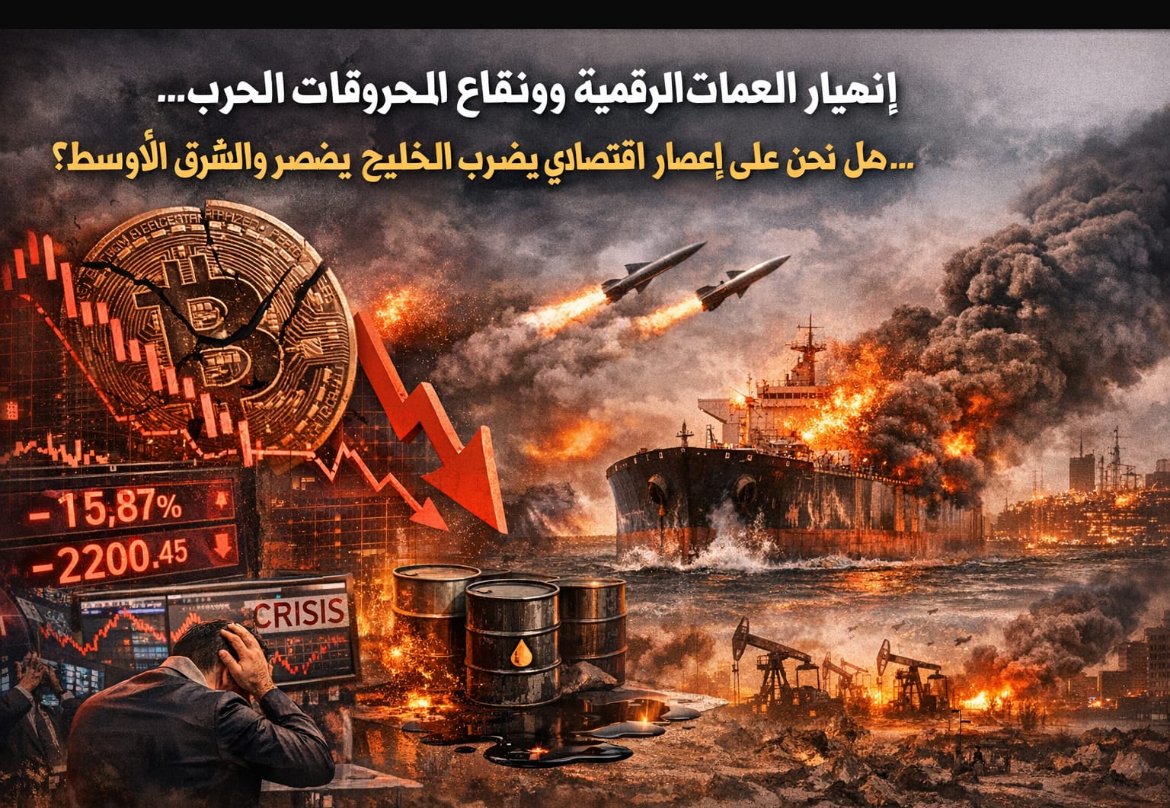
Media Commentator Dr. Magdy Kamel El-Hawary writes:
The Collapse of Cryptocurrencies and Soaring Fuel Prices Amid War… Are We on the Brink of an Economic Storm Hitting the Gulf, Egypt, and the Middle East?
When financial markets tremble, oil prices surge, and cryptocurrencies plunge within days, this is no longer ordinary volatility.
We are witnessing an exceptionally sensitive global moment—one that resembles the tense periods that preceded major crises in modern history.
Military tensions in the Gulf region, coupled with mounting concerns over navigation through the Strait of Hormuz, have brought a dangerous question back to the forefront:
Is the world on the verge of a new oil shock?
And could the current crisis evolve into a transcontinental economic catastrophe?
First: The Financial Collapse Scenario… If Markets Lose Their Nerve
Cryptocurrencies—led by Bitcoin—have begun a sharp decline amid escalating tensions. Yet the danger does not lie in Bitcoin alone, but in the psychological contagion that could spread to:
Global stock markets
High-risk investment funds
Banks exposed to digital asset investments
If the bleeding continues, we could witness:
A global sell-off across major exchanges
The bankruptcy of major trading platforms
A liquidity crisis striking emerging markets
In an interconnected financial world, it would take no more than a single week of global panic to transform volatility into a full-blown crisis.
Second: The Oil Shock Scenario… If the Strait of Hormuz Is Closed
The greatest danger lies in the disruption of maritime traffic through the Strait of Hormuz.
Any closure—even temporary—could push oil prices to record levels exceeding $150 or even $200 per barrel.
What would that mean?
A new wave of global inflation
Rising food prices
Supply chain disruptions
A slowdown in global economic growth
And at that point, the snowball effect would begin.
Third: The Impact on the Gulf… Between Gain and Risk
Gulf states face a complex equation.
Potential Gains:
Higher oil revenues
Massive fiscal surpluses
Increased government liquidity
Risks:
Targeting of oil facilities or ports
Capital flight and foreign investment withdrawal
Delays in major development projects
Escalating security and military pressures
Any direct military escalation in the Gulf could swiftly transform the region from a beneficiary of high oil prices into a theater of economic attrition.
Fourth: The Impact on Egypt… The Silent Pressure
Egypt is not a major oil exporter; therefore, rising prices represent a direct burden:
Higher energy import bills
Pressure on the local currency
Increased transportation and production costs
A new inflation wave affecting ordinary citizens
Moreover, any disruption in global trade or traffic through the Suez Canal could significantly reduce a vital source of national revenue.
Fifth: The Middle East… A Region on the Fault Line
The entire region faces intertwined scenarios:
Energy-importing nations will suffer severe inflation
Energy-exporting countries may profit financially but pay a security price
The possibility of the war expanding to include regional or international actors
If major powers intervene directly, we may witness a reshaping of alliances and economic dynamics across the region.
Sixth: The Worst-Case Scenario… What If the Storms Converge?
The greatest risk does not lie in a single event—but in the convergence of crises:
A collapse in cryptocurrencies
A sharp stock market downturn
A historic oil shock
Major banks or funds facing distress
A new global recession
At that point, the crisis would no longer be regional—it would be global.
Are We Facing an Inevitable Catastrophe?
For now… no.
However, indicators suggest that the world stands on the edge of significant financial fragility.
Global debt levels remain high, inflation has not been fully resolved, and economic growth remains fragile in many countries.
Any additional spark could push the global financial system into a broader phase of instability.
Conclusion
The Gulf stands between oil gains and the risks of war.
Egypt faces potential inflationary pressures.
The Middle East as a whole is living through a pivotal moment.
We are not yet in the eye of the storm…
But the winds are clearly intensifying.
The real question is not:
Will the crisis occur?
But rather:
Do we have concrete plans to withstand the shock if this storm turns into a global economic earthquake?