
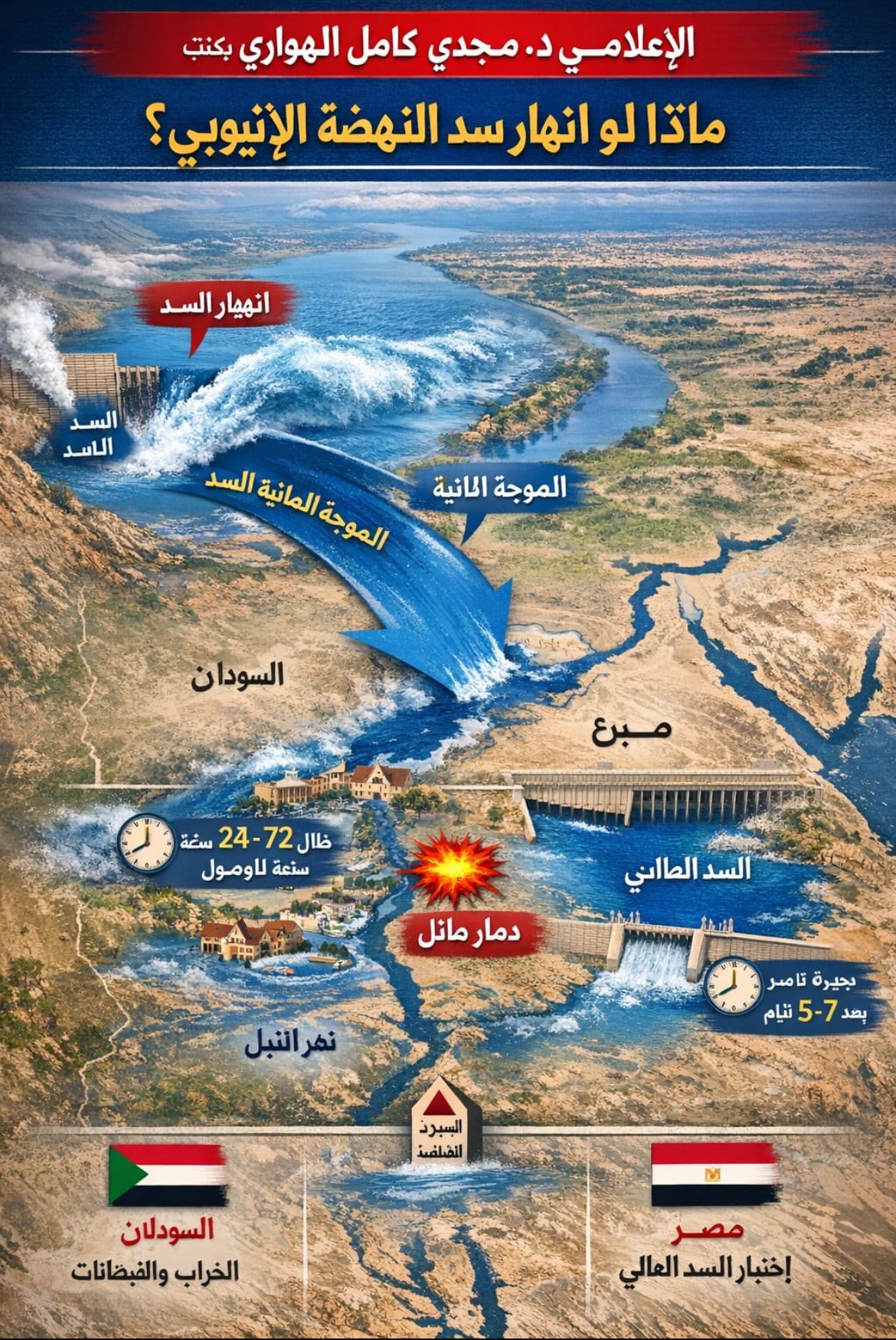
Media Personality Dr. Magdi Kamel El-Hawary Writes:
What If the Grand Ethiopian Renaissance Dam Collapsed?
In one of the most sensitive strategic issues on the African continent, the Grand Ethiopian Renaissance Dam (GERD) stands as a massive engineering project whose implications extend far beyond electricity generation to the very core of national and water security for downstream nations.
Yet beyond political debate, one pressing question remains:
What if the dam were to collapse suddenly?
First: The Current Technical Picture
With a storage capacity of approximately 74 billion cubic meters, the dam holds back a body of water comparable to a historic mega-flood.
In recent years, engineering analyses and satellite imagery have circulated indicating:
Surface cracks in parts of the concrete structure.
Erosion cavities and ground subsidence in front of the central spillway due to sustained water discharge.
Limited turbine operation compared to the announced design capacity.
There is no official confirmation of an imminent collapse risk. However, the scale of the project and its geological complexity—located in a seismically active region—mean that even minor structural concerns attract serious regional attention.
Second: Timeline Analysis of a Hypothetical Collapse Scenario
If we assume—purely hypothetically—a sudden total structural failure, an enormous flood wave would surge downstream along the Blue Nile.
Phase One: From the Dam Site to Khartoum
Approximate distance: 1,000–1,200 km
Estimated arrival time of the main wave: 24 to 72 hours
(depending on flow velocity and terrain conditions)
At this stage, Sudan would face the most immediate and severe impact.
Phase Two: From Khartoum to the Egyptian Border
Additional distance: approximately 1,500 km
Estimated travel time: 3 to 5 more days
During this stretch, the wave would gradually lose part of its destructive energy, but the sheer volume of water would remain immense.
Phase Three: Reaching Lake Nasser
At this point, the region’s primary defensive structure comes into play: the Aswan High Dam.
Lake Nasser possesses vast storage capacity, and the dam was engineered to withstand exceptional flood conditions. However, the sudden arrival of tens of billions of cubic meters within a short period would create unprecedented hydrological pressure.
Third: Estimated Scale of Damage (Theoretical Projections)
⚠️ These are theoretical estimates based on flood modeling scenarios, not official figures.
Sudan
Cities and villages along the Blue Nile could face inundation exceeding several meters.
Severe damage to infrastructure (bridges, roads, power facilities).
Extensive agricultural losses.
Preliminary, unofficial economic assessments suggest damages potentially reaching billions of dollars within days.
Geographically, Sudan would be the most vulnerable link in this scenario.
Egypt
Thanks to the presence of the Aswan High Dam:
A significant portion of the hydraulic shock would likely be absorbed.
Lake Nasser levels could rise sharply.
Emergency spillway releases might be required.
Temporary disruptions could affect irrigation and power networks.
While less catastrophic than in Sudan, potential impacts in Egypt could include:
Enormous operational pressure on water management systems.
Agricultural losses in low-lying areas.
High emergency management costs.
Fourth: The Worst-Case Scenario — What Does Total Collapse Mean?
In the event of a complete, instantaneous failure:
The first flood wave near the dam could rise to tens of meters in height.
Destructive force would be extreme in the first hundreds of kilometers.
Gradual reduction in wave height moving northward, though risk would not disappear.
A partial collapse, meanwhile, could generate successive waves—sometimes more dangerous than a single surge due to unpredictability.
Fifth: Is Collapse Technically Likely?
Large dams are designed under stringent international safety standards.
However, risk factors may include:
Seismic activity in the Horn of Africa region.
Potential design or construction deficiencies, if any exist.
Uneven or imbalanced turbine operation.
Absence of a binding agreement ensuring real-time data exchange during emergencies.
The real danger lies not only in structural failure—but in the absence of a coordinated early-warning system and immediate basin-wide response mechanism.
Conclusion
Discussing the collapse of the Grand Ethiopian Renaissance Dam is not a call for panic. It is an analytical examination of worst-case scenarios surrounding a structure that retains 74 billion cubic meters of water.
Sudan would stand at the heart of the storm.
Egypt would face a major engineering stress test.
Ethiopia itself would confront a humanitarian and economic disaster.
The ultimate question remains:
Will risks be managed through science, transparency, and cooperation?
Or will we wait until the waters speak—when words are no longer enough?